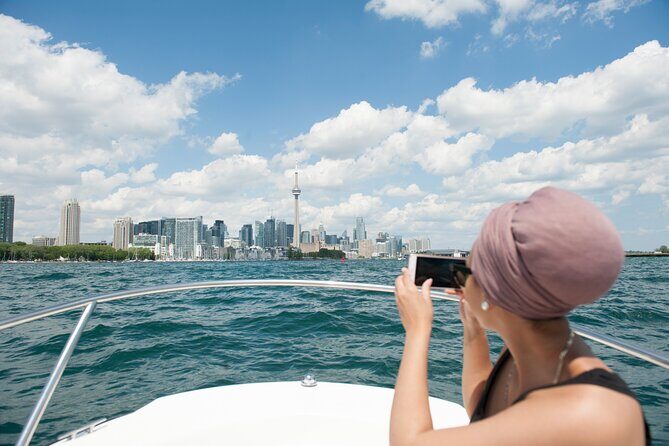
REVIEW · TORONTO
Toronto’s Waterfront: a Smartphone Audio Walking Tour
Book on Viator →Operated by Tripvia Tours · Bookable on Viator
Toronto’s waterfront gets smarter when you add audio. This smartphone walking tour uses live GPS and auto-playing commentary so you can explore at your pace, from Sugar Beach to Princes’ Gates.
I love that it’s not locked into a tight group schedule. You can pause, start again, and spend extra time where you actually care.
My second favorite thing: for $8.21, you get real context for landmarks you’d otherwise just pass by. The route mixes views (CN Tower, Rogers Centre) with factory stories and waterfront art.
The one possible drawback to plan for is simple: you’ll need your own smartphone, and while audio can play from your device speaker, headphones aren’t included.
In This Review
- Key Highlights You’ll Notice Fast
- A Waterfront Walk You Control From Your Phone
- Price and Time: Why $8.21 Feels Like More Than a Snack
- Before You Start: Download on Wi‑Fi, Then Go Offline
- Stop-by-Stop: Sugar Beach to Princes’ Gates
- Sugar Beach: Where the Waterfront Story Starts
- Queens Quay and Lower Jarvis Street: The Industrial Side
- Redpath Sugar: Factory Meets Waterfront
- One Yonge Street: Newspapers Were Part of the Skyline
- Yonge Street and Guinness-Record Trivia
- Jack Layton Statue and the Ferry Terminal Area
- York Street and the Island View
- The Power Plant: Contemporary Art by the Water
- Simcoe WaveDeck: Art You Walk On
- CN Tower View: Big Icon, No Ticket Needed
- Rogers Centre View: Blue Jays Country
- HTO Park: A Name With a Story
- Spadina Avenue and Lake Shore: A Song Reference Break
- Toronto Music Garden: Design Story Time
- Billy Bishop Airport Views Near Queens Quay West
- Little Norway Crescent: WW2 Commemoration
- Waterfront Trail and Martin Goodman Trail: The Long Walk Feeling
- HMCS NCSM York: Into Navy Territory
- Princes’ Gates: The End Point With Energy
- Who This Tour Suits Best (and Who Might Skip It)
- Should You Book This Toronto Waterfront Audio Tour?
- FAQ
- How much does the Toronto Waterfront smartphone audio tour cost?
- How long does the tour take?
- What language is the tour available in?
- Do I need cell service during the walk?
- Are headphones included?
- Where do I start and end the tour?
- Are tickets included for CN Tower and Rogers Centre?
Key Highlights You’ll Notice Fast

- Live GPS auto-play means the guide starts when you reach each spot
- Stop & start anytime with no time pressure, built for breaks and detours
- Location trivia game adds a fun layer while you’re walking
- Strong mix of sights from Sugar Beach to the Princes’ Gates and CNE area
- Offline-friendly setup lets you download on Wi‑Fi before you go
- Value pricing keeps the experience budget-friendly, even with optional attractions nearby
A Waterfront Walk You Control From Your Phone
This is a Toronto intro that feels modern and low-stress. Instead of joining a loud, crowded group, you move when you want, stop when you want, and keep going when you’re ready. If you like wandering but hate missing the “why does this matter” part, the format works well.
The key idea is that your phone becomes the guide. As you get close to each named location, the commentary plays automatically. You also get a live map showing where you are and where to go next, which helps a lot along a long, changing shoreline.
If you’re visiting Toronto for the first time, this is also a nice way to spot what you want to return to later. Big icons show up, but so do the smaller details that make the waterfront feel like a place with personality, not just a walkway.
Other walking tours we've reviewed in Toronto



Price and Time: Why $8.21 Feels Like More Than a Snack

At $8.21 per person, this tour is priced like an add-on, not a major activity. That matters in Toronto, where the cost of doing “a few things” can creep up quickly.
Duration is listed as about 45 minutes to 1.5 hours, depending on how slowly you move and how long you linger at views. Also, there are no time constraints. So if you want to linger at the Power Plant or take extra photos near the island lookouts, you can.
Here’s how I’d frame the value: you’re paying for curated storytelling plus a route that keeps you from second-guessing where you’re going. Since many stops are exterior and free to view, you’re basically buying interpretation more than admissions.
One more practical note: several stops are marked as admission ticket free, but the tour also includes viewpoints for major attractions where entry tickets are not included (CN Tower and Rogers Centre). So you’re not paying extra just to follow the walking story.
Before You Start: Download on Wi‑Fi, Then Go Offline

Plan to do one small task before you leave: download the tour on Wi‑Fi. The setup is designed so you don’t need signal or mobile data during the walk.
You’ll also want to think about battery life. Since your phone handles both GPS and audio, keep your screen brightness reasonable and bring a charged device. If your battery usually runs low on long city walks, this is the moment to be extra careful.
Also check the device rule: the number of travelers you select is the number of devices you can download the tour to. So if you’re traveling as a group and want everyone to use their own phone, match that during booking.
Finally, headphones are optional. The audio can play through the device speaker, but if you’re walking where sound might bounce (or if other people will be close), headphones will probably make the experience feel smoother.
Stop-by-Stop: Sugar Beach to Princes’ Gates
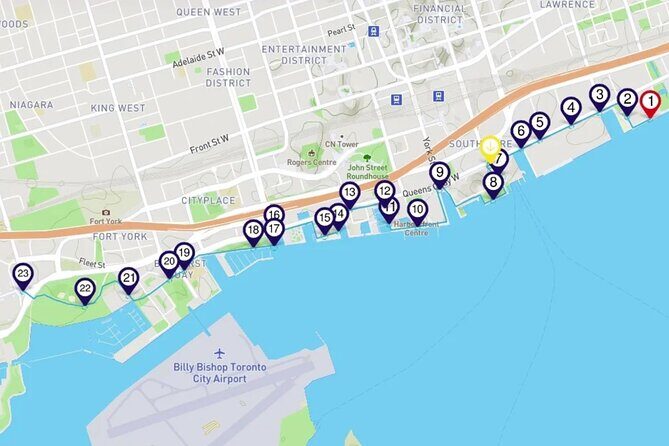
This route is essentially a long ribbon of waterfront, stitched together by short learning moments. Each stop is built around a specific place name, so you always know what you’re looking at and why it’s there.
The tour starts at Sugar Beach (St Lawrence-East Bayfront-The Islands) and ends near Princes’ Gates, which is the entrance area for the CNE. The experience is very similar either direction, so you can match it to what else you plan that day.
Sugar Beach: Where the Waterfront Story Starts
You begin at Sugar Beach, where the guide turns the waterfront into something you can read. Expect views and introductions to what’s coming next, with the CN Tower and Rogers Centre showing up as landmarks you’ll keep seeing.
You also get the tour’s first real “walk and listen” setup: your phone’s GPS map helps you orient, and when you approach the next point, the commentary starts without you tapping anything.
If you only have one visit to this shoreline, this is a smart opening stop because it sets context for the whole stretch.
A few more Toronto tours and experiences worth a look




Queens Quay and Lower Jarvis Street: The Industrial Side
The tour then shifts into a different tone at Lower Jarvis Street & Queens Quay East. Here, the focus is Toronto’s industrial past and how industry helped shape the city.
This is a great reminder that waterfronts are never only about views. They’re also about work, transportation, and what cities needed to grow.
One nice thing about the audio format: you don’t have to guess what you’re looking at. You get the “why” while you’re still standing in front of it.
Redpath Sugar: Factory Meets Waterfront
Next up is Redpath Sugar Toronto, presented as an iconic waterfront factory. The tour gives you the history angle, so you’re not just staring at a recognizable structure with no story attached.
For photo lovers, this is often the moment where the waterfront starts to look more architectural and less generic. You’re trading “pretty skyline” for “place with purpose.”
One Yonge Street: Newspapers Were Part of the Skyline
At One Yonge Street, you’ll be pointed toward the Toronto Star Building and learn about its long-running connection to newspapers since 1892.
This stop works well if you like learning what powered daily life in a city. It also adds variety, because the walk isn’t only about towers and parks.
Yonge Street and Guinness-Record Trivia
At Yonge Street & Queens Quay West, the guide brings up a fun fact about the street once holding a Guinness World Record for the longest road. It’s a quick story beat, but these small “did you know” moments are exactly what the audio format does best.
Plus, this kind of trivia pairs well with walking. You hear it while you’re literally next to the street, not later while reading.
Jack Layton Statue and the Ferry Terminal Area
Then you reach the Statue of Jack Layton and nearby the Jack Layton Ferry Terminal area. The tour points out the waterfront fixture and shares context about Jack Layton.
If you prefer city stories with people behind them, this stop gives you that human layer. It also keeps the walk from feeling like a checklist of landmarks.
York Street and the Island View
At York Street & Queens Quay West, you get a chance to look out toward the island view. The tour frames what you’re seeing, so the skyline feels more connected to place.
This is also a good stretch to pause for photos, since you can take in the perspective without needing admission tickets.
The Power Plant: Contemporary Art by the Water
Next is The Power Plant, a Contemporary Art Gallery. The guide explains why you might want to visit, which is useful if you’re deciding on your schedule later.
Even if you don’t enter, the stop helps you see the waterfront as a cultural zone, not just a scenic one.
Simcoe WaveDeck: Art You Walk On
At Simcoe WaveDeck, the tour calls out the artwork and what it is you’re actually stepping near. It’s one of the more playful stops because you’re looking at something designed to be seen from different angles.
This is a spot where it helps to slow down a little, because the point of the art is its form.
CN Tower View: Big Icon, No Ticket Needed
You’ll reach CN Tower as part of the walk. The important detail: the tour notes admission is not included. That means you’re likely getting exterior viewing plus commentary, not entry.
The upside is that you still get the story while you’re close enough to really notice scale. If you’re on a budget or your time is tight, you can enjoy the CN Tower without paying for the attraction.
Rogers Centre View: Blue Jays Country
Similarly, at Rogers Centre, the guide frames what the building is and its connection to the Blue Jays. Admission is not included here either.
This stop is best for perspective. You’re learning what the stadium represents while keeping your feet on the waterfront trail.
HTO Park: A Name With a Story
At HTO Park, the tour explains the interesting origin of the name and gives you context as you stroll through.
Parks can feel like filler on some walking tours. Here, the guide tries to prevent that by giving you a reason to pay attention.
Spadina Avenue and Lake Shore: A Song Reference Break
At Spadina Avenue & Lake Shore Boulevard West, you’ll get a good view of one of Toronto’s busiest and most popular streets. You also get an 80s song reference about the Spadina Bus.
This is one of those “audio tour perks” stops. It doesn’t just tell you what to see; it adds sound to the sense of place.
Toronto Music Garden: Design Story Time
At Toronto Music Garden, you’ll meander through a garden with a unique design story. The guide focuses on what makes the design interesting and explains the background.
This is the moment where the walk becomes more peaceful. If you like gardens, details, and intentional design, this is a good stop to slow down and let the story land.
Billy Bishop Airport Views Near Queens Quay West
At Queens Quay West & Bathurst Street, you’ll see the view toward Billy Bishop Airport (from the waterfront) and learn about it.
This is a surprising Toronto angle. You don’t always expect air traffic to show up as a talking point on a waterfront walk, but here it does—and it adds variety.
Little Norway Crescent: WW2 Commemoration
At Little Norway Crescent, the tour points out a small park connected to World War Two commemoration.
If you like memorials and community-linked stories, this stop adds meaning. It’s also a nice reset before the walk continues toward the more classic “big gates” destination.
Waterfront Trail and Martin Goodman Trail: The Long Walk Feeling
The tour keeps moving along the Waterfront Trail and also highlights the Martin Goodman Trail, noting it spans waterfront for over 20 km.
Even though you’re only walking a portion, the narration helps you understand you’re not just going from stop to stop. You’re part of a long shoreline route that locals use all the time.
If you’re considering a future longer walk, this is the stop where you start imagining yourself continuing beyond the tour.
HMCS NCSM York: Into Navy Territory
At HMCS NCSM York, the tour turns military. You’ll point out the waterfront fixture since 1959 and learn about its purpose.
This one adds weight to the waterfront story. The shoreline becomes more than a leisure space when you learn what it has held over time.
Princes’ Gates: The End Point With Energy
You finish at Princes’ Gates, with the guide explaining the gates and noting the CNE that runs inside them each year.
Ending here makes sense because it puts you at a lively threshold where you can keep exploring right away. If you’re pairing this with a day of attractions, you end at a convenient “switch to something else” zone.
Who This Tour Suits Best (and Who Might Skip It)

This tour is ideal if you:
- want a first-time Toronto orientation without paying for a lot of separate admissions
- dislike crowded group tours and prefer walking with your own rhythm
- like learning while you move, especially through short stops and guided viewpoints
- want a low-cost way to connect major landmarks (CN Tower, Rogers Centre) with smaller local stories
You might choose something else if you need a tour that includes indoor time or ticketed access as part of the package. Since CN Tower and Rogers Centre admission tickets aren’t included, you’ll only get the learn-by-looking version unless you decide to enter separately.
Also, if you’re someone who hates using a phone while walking, this might feel like extra effort. But if you can handle a quick audio experience in your headphones (or device speaker), it’s a very practical way to see the waterfront.
Should You Book This Toronto Waterfront Audio Tour?

I’d book it if you want a budget-friendly, self-paced way to understand Toronto’s waterfront instead of just taking photos and moving on. The format is built for flexibility: download before you go, follow the GPS map, and let the commentary start as you arrive at each stop.
It’s also a strong pick if you’re trying to fill time between other plans. You can keep it short, stretch it out, and stop exactly where it gets interesting for you.
If you’re willing to bring your own smartphone and accept that you’ll view CN Tower and Rogers Centre from outside, this tour offers a lot of value for the price.
FAQ

How much does the Toronto Waterfront smartphone audio tour cost?
It costs $8.21 per person.
How long does the tour take?
The duration is listed as approximately 45 minutes to 1.5 hours.
What language is the tour available in?
The tour is offered in English.
Do I need cell service during the walk?
No. You download the tour on Wi‑Fi before you go, and the tour is designed so you don’t need signal or data during the experience.
Are headphones included?
Headphones are not included. The audio will play from your device speaker, and headphones are optional.
Where do I start and end the tour?
You start at Sugar Beach (St Lawrence-East Bayfront-The Islands) and the tour ends near 800 Lake Shore Blvd W, at the Princes’ Gates entrance area for the CNE.
Are tickets included for CN Tower and Rogers Centre?
No. Attraction tickets are not included for CN Tower and Rogers Centre.