REVIEW · TORONTO
Toronto Old Town: Self-Guided Dark History Walking Game
Book on Viator →Operated by Questo · Bookable on Viator
Toronto Old Town gets more interesting when you solve clues. This self-guided dark history walking game uses the Questo app to turn major landmarks into a puzzle route, with offline-ready story content you can follow at your pace. The main trade-off is that there’s no physical tour guide, so you’ll need to pause, read, and look around yourself to answer each challenge.
You start at Toronto City Hall and finish at St Lawrence Market, moving through 10 stops with step-by-step directions inside the app. I like this format because it’s naturally good for groups: friends or family can tackle the puzzles together, then split up briefly if someone needs a photo or a snack.
The route is built to run in about 1 hour 30 minutes, but you can slow down, pause, or resume anytime. Just remember it’s an active walk with lots of attention to small details, not a sit-and-enjoy ride.
In This Review
- Key things to know before you play
- How the Questo dark-history game works on your phone
- Starting at Toronto City Hall: getting oriented and finding the first clue
- Old City Hall: when the city built its power
- The TD Centre and Oscar Peterson Place: modern towers, designed pauses
- Fairmont Royal York: royal arrivals and celebrity gravity
- Hockey Hall of Fame at Brookfield Place: sports history, relocated location
- King Edward Hotel: fireproof claims and early-1900 ambition
- St James Cathedral and St Lawrence Hall: older institutions with a long timeline
- Ending at St Lawrence Market South: your finish and your reward
- Price and value: what $8.44 really buys you
- Who should book this self-guided Toronto dark-history route
- Quick practical notes before you start
- Should you book this Toronto Old Town dark-history walking game?
- FAQ
- How long does the Toronto Old Town self-guided dark history game take?
- Where does the game start and where does it end?
- Do I need Wi-Fi during the walk?
- What’s included in the experience?
- Is there a physical tour guide with you?
- What language is the game offered in?
- Is this activity private or shared with other groups?
- Are service animals allowed?
- Is free cancellation available?
Key things to know before you play
- Self-paced route from City Hall to St Lawrence Market in about 90 minutes
- 10 puzzle challenges tied to a dark-history storyline across Old Town landmarks
- No Wi‑Fi needed after the initial download, helpful for spots with spotty service
- Works best for groups who like friendly competition and shared problem-solving
- Step-by-step guidance in the Questo app (no physical guide included)
- English mobile experience with a mobile access code and flexible pacing
How the Questo dark-history game works on your phone
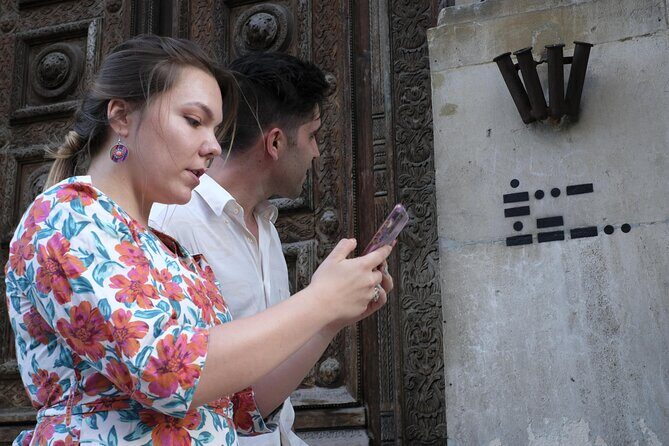
This isn’t a traditional guided tour where someone talks and you follow. Instead, you get a mobile access code and story content inside the Questo app, plus a sequence of 10 puzzle challenges. The app guides you step by step toward the next stop, and each location asks you to look around and answer a challenge before you move on.
That design matters for how you’ll experience Toronto. When you’re solving clues, you notice the “boring” stuff—signs, architectural details, and placement—because that’s often what the puzzle wants. If you like independent travel but still want structure, this hits a sweet spot.
Also, the offline angle is real. You’ll do an initial download, then you can keep going without Wi‑Fi. That’s a practical advantage in dense downtown blocks where cell service can wobble.
One more thing: you can pause and resume anytime. So if you run into a crowd outside a major landmark or you want to duck into a break in the middle, you’re not forced to keep moving at someone else’s tempo.
Other Old Town Toronto tours we've reviewed in Toronto


Starting at Toronto City Hall: getting oriented and finding the first clue
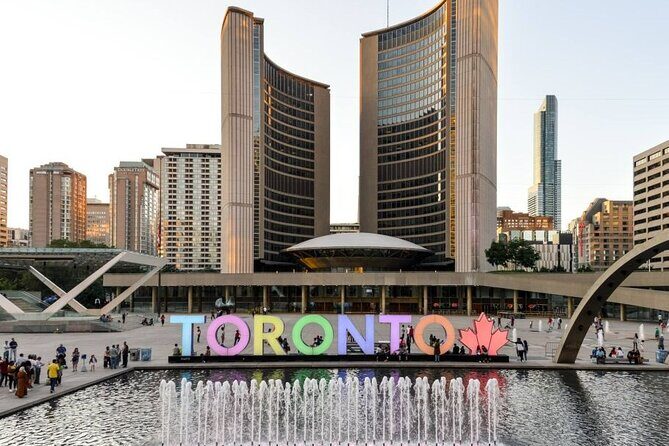
You begin at Toronto City Hall (100 Queen St W, Toronto), then the app walks you forward toward your first challenge. In this game, the first stop is linked to a notable sign that started life as a temporary attraction for the 2015 Pan American Games.
Here’s what makes this opening moment fun: it’s not just a landmark lecture. You’re prompted to search around for the answer to move ahead, and the story behind the sign is basically about Toronto’s relationship with tourism. It was planned to be taken down as early as November 2016, but it stuck around because it became popular with tourists and residents.
Practical tip: City Hall area sidewalks can be busy and people-moving is constant. Start with a clear idea of where you’re going next inside the app, then give yourself a few extra seconds to find the exact spot the clue is asking about. The puzzles reward careful looking.
Old City Hall: when the city built its power
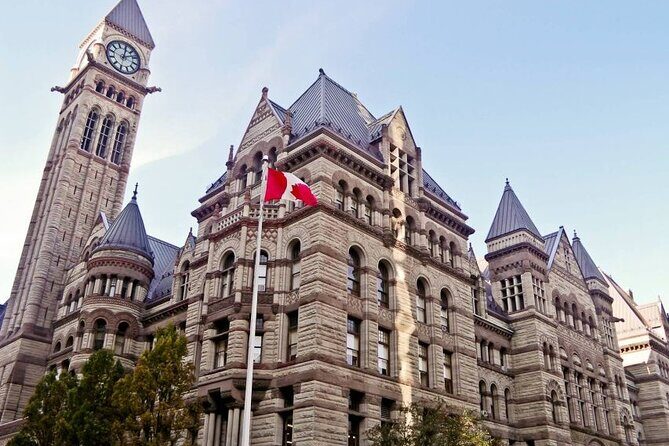
Your route then brings you to Toronto’s Old City Hall—an 1899 landmark that was once the largest civic building in North America at completion. It also served multiple roles: municipal government and courts for York County and Toronto, after taking over from the Adelaide Street Court House.
Why this stop works in a clue-game format: Old City Hall isn’t just a pretty façade. The app turns it into a setting where you have to actively locate information or details to advance. That makes the building feel less like a backdrop and more like a real part of how Toronto ran day-to-day life—especially when institutions of government and justice were physically concentrated in one major structure.
Possible drawback: buildings like this can have busy foot traffic and lots of angles. If you’re the type who dislikes searching and prefer straight-line sightseeing, you may want to give yourself extra time here so you don’t feel rushed.
The TD Centre and Oscar Peterson Place: modern towers, designed pauses
Next up, you reach the Toronto-Dominion Centre in the Financial District. The TD Centre is an office complex owned by Cadillac Fairview, with the Toronto-Dominion Bank as its anchor tenant. It’s made up of six towers and a pavilion with bronze-tinted glass and black-painted steel, and about 21,000 people work in the complex.
If you’re expecting a quiet architectural stroll, this stop is different. The game places you between a heavy-working corporate zone and public spaces, and it’s a good reminder that the “dark history” theme doesn’t require abandoned buildings. It can also be tied to how cities function, who works where, and how downtown power is organized.
Then you move to Oscar Peterson Place, the open areas between the towers. The north space is described as more formal granite, while the south space includes the lawn and a sculpture called The Pasture by Saskatchewan artist Joe Fafard (he died in early 2019).
What I like about this pairing is the contrast: big towers around you, then a pause of outdoor granite and lawn space. Even if you’re only there for the puzzle, it gives you a breather. Use it. Step out of the rush, look around, and treat the open area as part of the experience rather than just a corridor.
Fairmont Royal York: royal arrivals and celebrity gravity
From the finance district, the storyline heads to the Fairmont Royal York. Over nearly 90 years, it has hosted royal guests, heads of state, celebrities, superstars of sport, and millions of others—an easy way to describe its role as a key anchor in Toronto luxury.
In a dark-history puzzle game, this kind of site can be especially interesting because grand hotels often sit at the intersection of private lives and public spectacle. You’re not just walking past a famous building. You’re asked to look around and answer a challenge that keeps the story thread moving.
One travel note: luxury hotels can be surrounded by formal spaces and controlled entrances. You’ll want to stick to public sidewalks and areas the route points you to. If a puzzle feels like it wants something you can’t reasonably see from the street, rely on what the app directs you to rather than guessing.
Other ghost & haunted tours we've reviewed in Toronto





Hockey Hall of Fame at Brookfield Place: sports history, relocated location
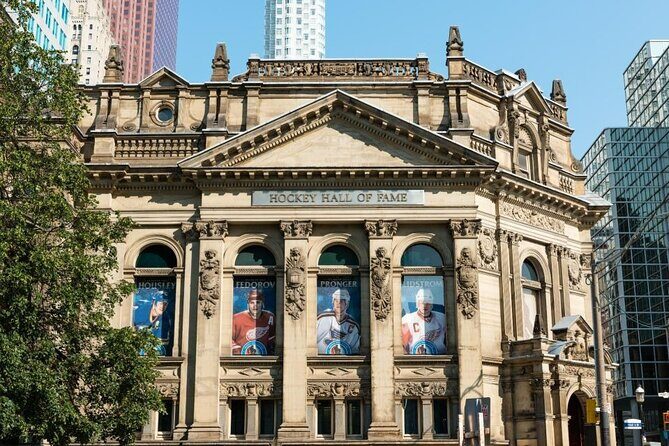
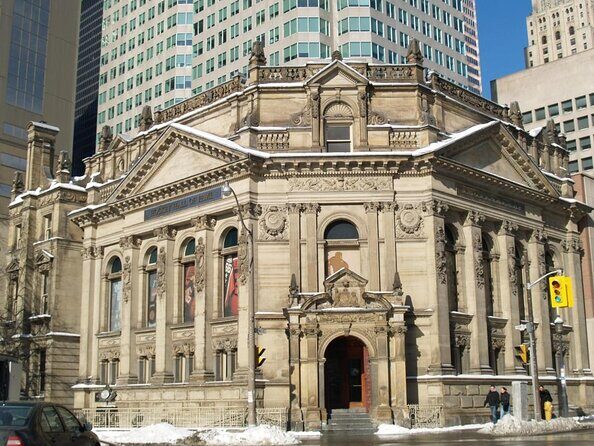
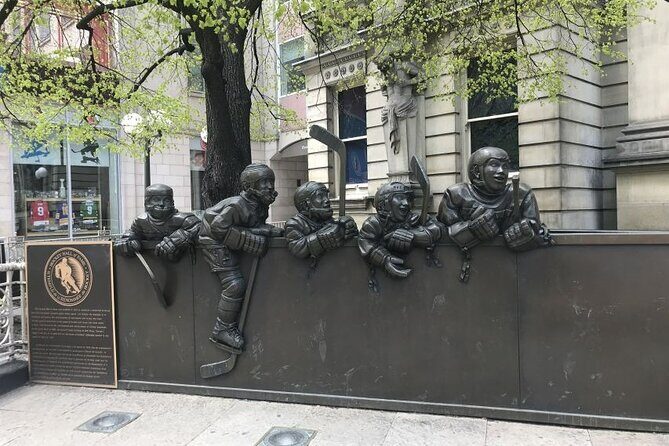
Your next clue stop links to the Hockey Hall of Fame, described as now inside Brookfield Place in a historic Bank of Montreal building. The Hall originally had its first permanent building at Exhibition Place in 1961, then relocated in 1993. It has also hosted IIHF exhibits and the IIHF Hall of Fame since 1998.
This stop is a good example of why a self-guided game works better than a quick “check the box” photo. Relocation stories make a landmark feel alive—like something that adapted as the city changed. And because the app asks you to find the answers on-site, you’ll likely notice exterior details and context around the building that you might otherwise skip.
Practical tip: if you’re playing on a busy day, treat this as a “look carefully first, crowd-second” stop. Let the puzzle lead your pace, not the line for the attraction.
King Edward Hotel: fireproof claims and early-1900 ambition
Next, you’ll encounter the King Edward Hotel. The building was designed by Chicago architect Henry Ives Cobb and Toronto architect E.J. Lennox for developer George Gooderham’s Toronto Hotel Company. It opened in 1903 with 400 rooms and 300 baths and claimed to be entirely fireproof. It also received its name from King Edward VII.
In terms of game play, this is another “look around and answer” moment. Big-name hotels are packed with recognizable architectural features, so you may find the clue easier to solve if you take a few seconds to read the building context and spot what the app is pointing you toward.
Who this stop is for: if you enjoy history through architecture and city growth, this is a strong chapter. You’ll get a real sense of early Toronto ambition—big infrastructure, big rooms, and big claims.
St James Cathedral and St Lawrence Hall: older institutions with a long timeline
You then move into two major civic-and-community landmarks.
First is Cathedral Church of St. James, an Anglican cathedral in Downtown Toronto. It’s the location of the oldest congregation in the city, with the parish established in 1797. That age gives the site a sense of deep continuity—even if your clue challenge keeps you focused on a specific question rather than a long lecture.
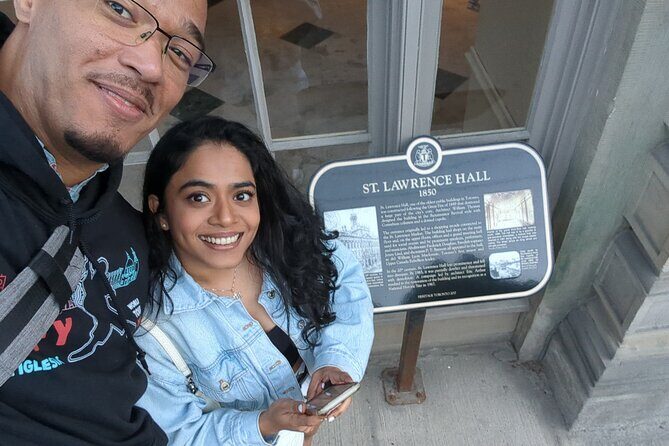
After that, your route includes St. Lawrence Hall. It opened in 1850 and was Toronto’s first large meeting hall. It’s named for Canada’s patron saint and, for many years, served as a centre of cultural and political life in Toronto—hosting balls, receptions, concerts, exhibitions, and lectures.
Why I think these work so well in a self-guided format: both sites represent long-running community roles. When you’re asked to solve something on location, you’re forced to interact with the site rather than just walking past it. It turns time itself into part of the puzzle.
Quick consideration: religious sites and heritage halls can have rules about access and photography. The data here doesn’t describe any specific restrictions, so follow posted signs and stay respectful.
Ending at St Lawrence Market South: your finish and your reward
The game ends at St Lawrence Market South (Toronto, ON M5E 1C3). The market is a major public market building at the southwest corner of Front and Lower Jarvis Streets, and it’s part of the larger St. Lawrence Market complex along with the North building and St Lawrence Hall.
This is a great finish because it’s both practical and satisfying. After around 1 hour 30 minutes of walking and puzzle-solving, you can naturally transition from “find the answer” to “browse and eat.” Even if you don’t buy anything, you’ll likely feel like you ended in a place that actually belongs in a Toronto checklist—without needing to rush.
Price and value: what $8.44 really buys you
At $8.44 per person for about 1 hour 30 minutes, the value here isn’t comfort or a guide on demand. You’re paying for structure: a mobile access code, a prebuilt storyline, and 10 puzzle challenges that get you moving through Old Town landmarks from City Hall to St Lawrence Market.
If you’re traveling with friends or family, the group angle can boost value because the app format is built for shared participation. And since there’s no physical tour guide included, you don’t have to wait for someone else’s schedule. You can pause, resume, and keep going at your own pace.
If you’re the kind of traveler who loves being told stories by a person, you might miss that live commentary. In that case, consider this game as a guided-by-the-app experience, not a replacement for a classic walking tour.
Who should book this self-guided Toronto dark-history route
I’d point this direction if you:
- like walking but want more than “look and move”
- enjoy puzzles or light competition with a group
- want a structured route that still allows pauses and a self-set pace
- prefer an app-led experience, with offline content after download
I’d think twice if you:
- hate reading on your phone while walking
- dislike searching for answers in public spaces
- want a full human-led history talk at every stop
Quick practical notes before you start
- Download the app content first, then rely on the offline play.
- Plan for a full attention cycle: you’ll be looking around to answer each challenge.
- Wear comfortable shoes. It’s downtown, and the time estimate assumes you’ll keep moving.
- Because it’s private for your group, you can decide how to split tasks and solve faster or slower.
Should you book this Toronto Old Town dark-history walking game?
If you want a low-cost way to turn downtown landmarks into an interactive scavenger walk, this is a strong choice. The combination of 10 puzzle challenges, a guided app route from City Hall to St Lawrence Market, and offline-friendly content makes it practical and flexible—especially for groups who enjoy solving things together.
If you’re craving a guided lecture with a person leading the narrative, this won’t feel the same. But if you like to travel with your own tempo and let the city’s details do the talking (and the app doing the prompting), it’s a smart way to spend 90 minutes in Toronto.
FAQ
How long does the Toronto Old Town self-guided dark history game take?
It takes about 1 hour 30 minutes.
Where does the game start and where does it end?
It starts at Toronto City Hall (100 Queen St W, Toronto) and ends at St Lawrence Market (Toronto).
Do I need Wi-Fi during the walk?
No Wi-Fi is needed after the initial download.
What’s included in the experience?
You get a mobile access code, 10 puzzle challenges, storyline content about Old Town’s dark history, and the ability to pause and resume anytime.
Is there a physical tour guide with you?
No. It’s guided step by step via the Questo app.
What language is the game offered in?
The experience is offered in English.
Is this activity private or shared with other groups?
This is a private tour/activity, so only your group participates.
Are service animals allowed?
Yes, service animals are allowed.
Is free cancellation available?
Yes. You can cancel up to 24 hours in advance for a full refund. Cancellation less than 24 hours before the start time isn’t refunded.